The Black Monk
Part 1
If you are driving along the Riviera from France into Italy, you can turn left after Ventimiglia and head North into a valley in the foothills of the Alps. You will follow a stream along a winding road through picturesque villages with equally romantic names like Dolceacqua and Isolabona. You will see arched bridges and ruined castles clinging to the cliffs, but the best is yet to come. As you emerge from the tunnel at Isolabona, you will catch a glimpse of the hill village of A------.
A------ sits atop an incredibly steep, narrow spur of land surmounted by a church tower from which terracotta-rooved houses tumble down to the road. Its few narrow streets climb up to a small piazza at the top from which the whole of the valley can be viewed. Now whilst the village presents a beautiful sight to the modern tourist, aesthetic considerations were not the reason such a precipitous and defensible site was chosen.
Seven centuries ago, the villagers dwelt in an adjacent valley; their small farms clustered around a stone Benedictine monastery and its community of black-cowled monks.
The community was isolated away from the road, and far from the coast; in the winter months, the snow would cut off the valley completely, the wolves howling in the mountains. The monks ruled over their lay brothers and sisters with little interference from the outside; masters of their valley.
Occasionally rumours of heresy, of necromancy and murders reached other villages. The stories centred around Abbot Rainaldo, that he kept a secret copy of the Key of Solomon and commanded the spirits of the air. That he was a fiend and could change shape into that of a wolf. It was also said that travellers would sometimes enter the monastery as guests but were never seen to leave.
The bishop dismissed these tales, believing them to be gossip and the slander of the Baron who coveted the church land. And as long as the tithe of olives continued to be paid, the Bishop was happy to turn a blind eye.
Eventually the clamour grew amongst the peasants, and fearing the secular authorities would become involved, the old Bishop sent a commission. In the spring of the following year the austere Arch Deacon Pietro accompanied by a learned priest, servants and men-at-arms made the ascent up to the Monastery.
However, upon arrival in the valley, they were met not by Abbot Rainaldo but his funeral procession, for the leader of the community had died in his bed the very night before.
The hooded monks bore his heavy lead coffin to the old Romanesque monastery church to inter their leader in the crypt, solemnly chanting in Latin. As the tomb was sealed, the Arch Deacon noted that the sarcophagus was first bound with heavy iron chains, a strange custom indeed.
The following day Pietro began interviewing the monks, probing their beliefs and practices, questioning if they adhered to official church doctrine and if any laws of the land had been broken. Certain testimony and obscure figures in the marginalia of copied texts were enough to confirm the Arch Deacons suspicions. Some of the late Abbot's books and personal effects were burned. The monastery was dissolved; the monks dispersed to other Houses of God, the land sold to the Baron.
If the Bishop had hoped that was the end of the matter, he was to be disappointed. A number of witnesses claim to have seen the deceased Abbot Rainaldo sometimes as a man at other times in the form of a wolf. The common folk refused to approach the crumbling and overgrown monastery, openly declaring the place to be accursed.
Increasingly, the villagers left building new homes at the foot of the Baron's new castle upon a high ridge above the road and the old village was abandoned.
The desolate valley was left to the beast and the birds, visited only occasionally by brave shepherds. The Monastery became a roofless ruin, trees growing where monks had once prayed.
And so, it would have remained deserted and forgotten but for the rise of Benito Mussolini's Fascist party. Il Duce was keen to return the Italian people to the land and settle families on new farms on unused lots. A new road was constructed, houses built, and olive groves planted.
The villagers were back working the land in the place their ancestors had forsaken. One young family, Giovanni and Maria Lanteri, moved into a new stone farmhouse with their three young children not far from the woods that covered the Old Monastery. The couple worked building terraces and planting trees whilst the little ones played.
At first things went well. The youngest, little Tonio, timidly spoke of seeing "Il Vecchio", the old man dressed in black who watched the house at night, but the others dismissed this as a child's nightmare. In November, as the olives were harvested from the trees before the winter nights closed in. The wind whipped down from the mountains, slamming into the shutters of the house, and Maria told her husband that she could hear voices on the wind – like the sound of chanting. Giovanni said he heard no such thing but was keen to lock the doors when darkness fell and borrowed a shotgun from a neighbour.
In January Little Tonio failed to return from an errand; his parents searched the path and the woods calling his name until darkness defeated them. The next day the whole village was roused, beating the undergrowth and checking barns and wells. Some of the children said that a big wolf had taken Tonio, but that was impossible, for all the wolves were long gone. The boy was never found, and the next year the Lanteri family left Italy to join Giovanni's cousin in Argentina.
Part 2
Sergeant Hütter pointed to the map "The partisans will not attack the village from the road down there; one sniper in the church tower could hold out against an entire battalion. But from this path above here, besides the graveyard, A------ can be taken."
He wondered if the new recruits were listening to a word he said, the whole lot of them not worth one of the men he'd lost in Russia.
"The track leads along this ridge and down into the neighbouring valley." His finger traced the snaking contour lines on the map.
"We have intelligence that the partisans meet here at a ruined monastery." The finger now jabbed the paper. "We will make our way down there under the cover of night and set up ambush positions. When it gets dark, we move; stay alert, no talking. Let's give these Bolsheviks a surprise."
Bartos, a young, gangly recruit, was gazing wistfully at the view. Hütter despaired at keeping these boys alive. The squad should be nine strong, but now they were only seven, five of them youths in ill-fitting uniforms. Of the original unit, only two veterans remained: Schneider the machine gunner and Hütter himself.
"Bartos, wake up and check your equipment" he barked.
As the sunset behind the mountains, the frogs started their croaking chorus of "Egbert, Egbert" and the grenadiers began their patrol, keeping to the edges of the path. Hütter took the lead; behind him, the boys stumbled along whilst Schneider, a giant of a man, carried the hefty machine gun across his shoulder like Jesus bearing the cross.
The path led steeply upwards, zig-zagging up and over the hill, before turning downwards again. Hütter could hear the laboured breathing of the recruit bearing Schneider's ammunition. There was enough moonlight to see the valley – no village here, just a few scattered farmhouses, terraced olive groves and tangled woods.
Suddenly Hütter held his hand up – the others stopped as their leader crept forward. The Sergeant could see two small moving lights ahead in the undergrowth - lit cigarettes, perhaps? Deliberately and smoothly, he pulled the bolt back on his Schmeiser and stepped into the shadow of a tree. The lights flashed again, and he almost laughed with relief – the dancing sparks were fireflies.
Grinning, he beckoned the others forward, for now he could see a fork in the path leading to the monastery. Turning off, he picked up the pace now that their objective was close.
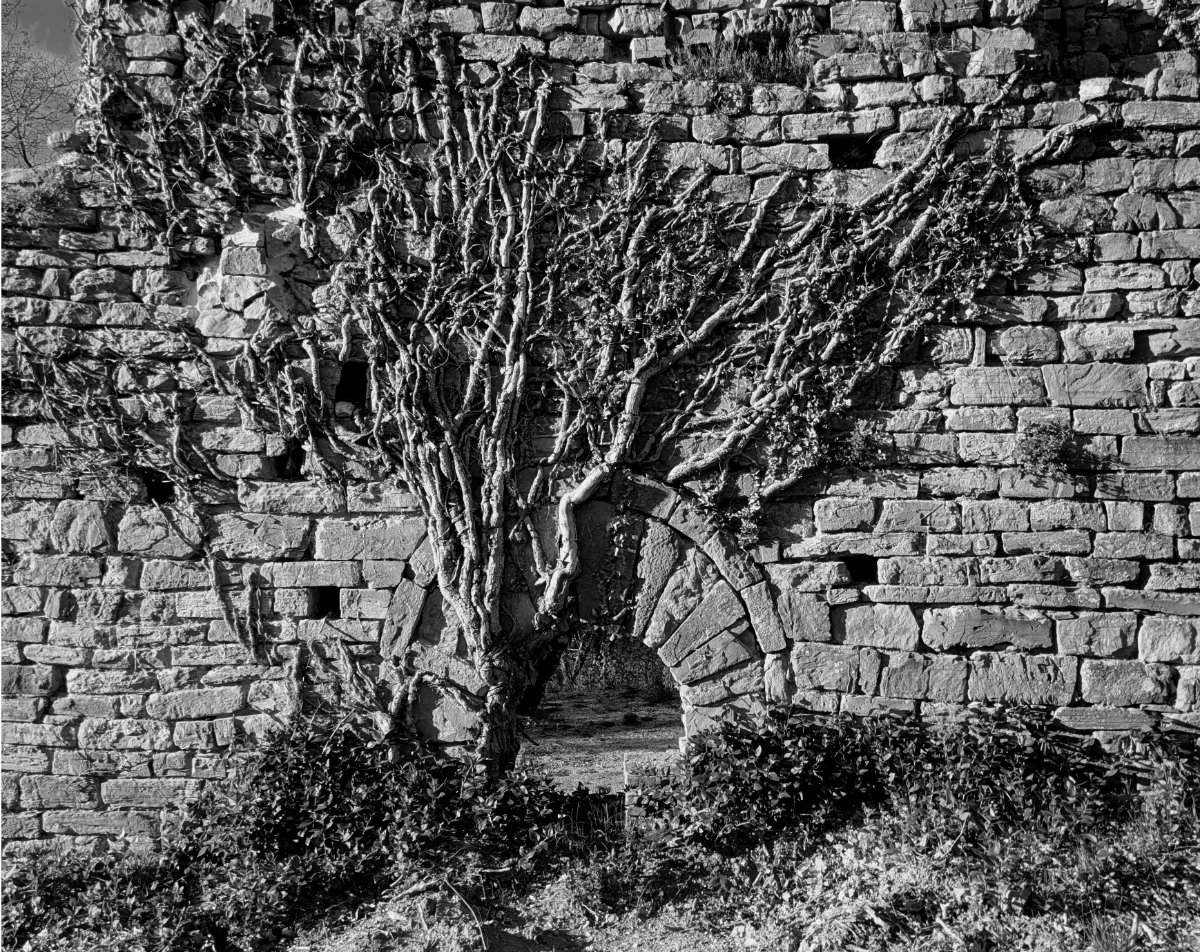
And then he could see it. A broken shell of a church on the edge of an escarpment, withered vines clinging to its shattered walls. Hütter clambered through an archway and looked inside. Others might have marvelled at the age of the ruin and wondered why it had been deserted, but as a Sergeant of the Wehrmacht he saw only one thing: a ready-made strongpoint. He turned to the others and spoke in a whisper, "Schneider and Flür, machine gun here in this archway covering the path. The rest stay back there in the treeline with me. Now it is easy to shoot a comrade in the dark, so don't fire until you are certain of a target."
The position was almost perfect for an ambush, and the partisans were nothing but a ragtag rabble of farmers, but the Sergeant felt uneasy. There was something wrong about this place, something that reminded him of the smell of death on a battlefield.
They waited, staring into the dark, trying to stay awake and concentrate; the frogs ceased their monotonous chanting, and the dogs stopped barking as silence filled the valley.
Hütter flinched as he could just make out a dark shape moving along the path. As it approached, he could see a solitary cowled figure the face covered, perhaps a priest? Something about the person's movements suggested an old man. What was this ancient fool doing roaming abroad at the midnight hour? Perhaps the partisans had sent him ahead to check the monastery was safe. If so, Hütter would take him prisoner and make him talk.
The hooded man limped towards the ruin directly facing the archway and the hidden machine gun. It was summer night in Italy but as the wind picked up, the Sergeant felt the cold of the winter war. The old man lifted his head to look directly into the archway.
Someone gasped, "Mein Gott" and then everything was sound and light as the machine gun opened fire. The muzzle was wreathed in flame, and tracer bullets sped like fireworks through the night. The men were dazzled and deafened by the gunfire, and Hütter's bellowed order of "Ceasefire!" was ignored by the gunner. What the hell was Schneider shooting at?
Abruptly the firing stopped; they must have used the whole belt.
"Anyone hit?"
No answer.
Hütter crawled out towards the spot the old man had been, where he expected to find an eviscerated corpse. At that range Schneider couldn't miss, and the machine gun would have cut anyone in half. But as he inched closer and his eyes readjusted to the dark, he realised the old man was gone.
"Scheiße!"
The ambush had been revealed, as the whole valley would have heard the gunfire and any partisans fled. But where was the old priest? Even if by some miracle he had not been hit, he could not have got far.
Hütter's thoughts were interrupted by sobbing coming nearby. "Whoever the fuck that is shut your mouth before I give you something to cry about."
"Sarge – Bartos is gone; he was just to the right of me," another voice "His rifle is here, but he's gone."
"Bartos, stop taking a shit and get back to your post", Hütter yelled.
"Bartos!"
But only the wind answered.
Part 3
I am sitting now, writing this in the holiday home of my wife's mother in February, looking out over the valley. They say it never snows in A------, and yet is snowing outside, and a thick white blanket covers the hills. The houses built under Mussolini are now peopled by Dutch and English retirees, but few will be here in Winter. Long forgotten, the ruins of the monastery still stand among tangled trees a few hundred yards from this house.
Wolves have returned to the Alps, and some say they have been spotted this far South chasing the deer and wild pigs. It is getting dark outside, and the wind is picking up. And as I look out into the gloom, do my eyes trick me, or is it that cowled figure in black I see limping through the snow?